
Grading land by hand without bobcats, bulldozers, and heavy equipment? Is that even a thing? It is! And it isn’t as hard as you might think…

Clearing and grading land by hand is possible and you don’t have to be Iron Man to do it.
But before going too far, always keep safety in mind. Clearing and grading your own property means you’ll likely be interacting with untouched nature, which can be a beautiful experience. However, nature also contains various hazards. Potential interactions you may have include various critters, snakes, insects, poisonous plants, falling branches, larger wildlife, etc. Slippery, uneven terrain and weather (heat, dehydration) are also considerations.
Before going out into the wilderness, (even if it’s your backyard), it’s a good idea to be equipped with protective clothing including long thick pants, puncture resistant gloves and non-slip waterproof work boots. In addition, insect repellent, sun protection, proper hydration, and common-sense are must-haves. When in doubt, (i.e. that redwood tree you want to chop down is really big, the boulder you want to move is super heavy, you’re struggling to saw through the branch you’re sitting on) it’s better to get some help. Clearing and grading your own land manually is likely best suited for small projects, or a team. But it’s also important not to be scared to step out of your comfort zone.
Manually clearing and grading land for a tiny home or making small changes to your existing property yourself can be very enriching and rewarding. Digging in hands-on lets you get to know the land you’re living on at a deeper level. But there are some hand tools that will make the job much easier! Here are the top 5 hand tools that I wouldn’t be without for manual land grading.
1. Steel Bypass Lopper
(aka a large branch cutter)
Be honest, you were expecting a chainsaw right? What on earth could a branch cutter possibly be useful for in land clearing?
Many young trees, even taller ones (10 ft ish) have slender trunks (around 3 in or so). The branch loppers easily slice through anything under 2in, and by using multiple cuts you can work your way through thicker stems. The lever-style handle is great if you don’t have a ton of upper body strength. For particularly hard cuts you can position one lever against your body and use both hands to pull the other one towards you, using your back muscles in a rowing motion.
2. Pickaxe
I never would have guessed that the pickaxe would be one of my favorites, since it’s bulky and heavy. But that was because I wasn’t using it properly. The key is to raise it high enough so that gravity can use the weight of the metal head to propel it down with more force than you could generate with a regular axe. In this way, hard concrete-like soils with roots, rocks, and clay can be busted up.
In addition, the pickaxe is great for removing old tree stumps and logs. Some huge tree stumps might look at first glance like they need a tractor or bulldozer or something huge to remove them. This may be true if a tree was freshly cut, but stumps and parts of trees that have been decaying for years take on a light porous structure that breaks apart easily. If this is the case, the pickaxe can be used to bust up the rotting wood into pieces small enough to carry away.
The pickaxe is also good for chopping into roots on small stumps of freshly cut trees and breaking up old root systems. Handsaws and chainsaws can quickly become blunted and ruined by the dirt and rocks present in root systems. The pickaxe is heavy and durable enough to chop through roots and dig into rocky soil.
But on a safety note, the pickaxe is also good at slinging small rock chips and other debris in your general direction. Safety glasses or safety rated sunglasses and good situational awareness are essential. Also, some types of rocks can produce sparks if you contact them with the pick. Should this occur, it’s probably a good idea to slow down a bit if there are a lot of dry leaves nearby or other flammables.

3. Shovels
Obviously, shovels are essential for grading and landscaping. But there are different kinds, suited for different functions.
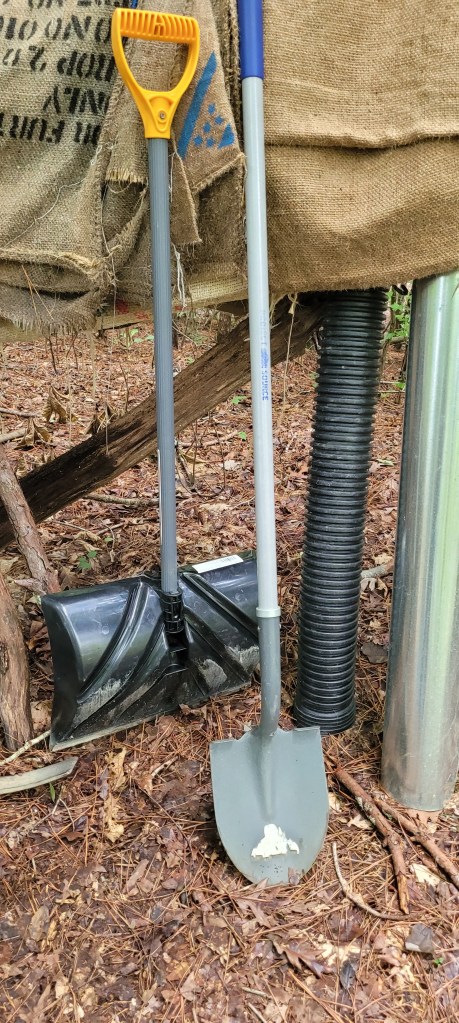
A shovel with a pointed tip is good for digging and prying up small plants and stems of undergrowth. Snipping off the main stem with the loppers is necessary, but at least half the tree or plant often resides under the surface, and can enable its regrowth. This points to the amazing resilience of nature but can be frustrating if you’re trying to prep land for building.
The pointed shovel is good for piercing through and digging out the root system. In combination with the pickaxe, even somewhat thicker stems and small stumps can be removed. However, I can say from experience that stumps greater than about 4 in in diameter are very hard to remove by hand. I did remove a 6 in stump by hand…with about 1.5 hr of hard labor. It is indeed incredible that such a slender tree can have such invincible roots. For larger stumps, I won’t say it isn’t possible but depending on your time constraints it may be more expedient and save a lot of hair-pulling to hire someone with a stump grinder.
Many think that a flat shovel isn’t good for anything except maybe a dustpan. But actually I’ve found a flat shovel to be useful. Since it is wider than the pointed shovel, it’s good for shoveling gravel or loose dirt. It’s also good for brushing aside yard debris that is too heavy for a rake. Also, it can help scrape and even sections of dirt that you dug out with the pointed shovel or pickaxe.
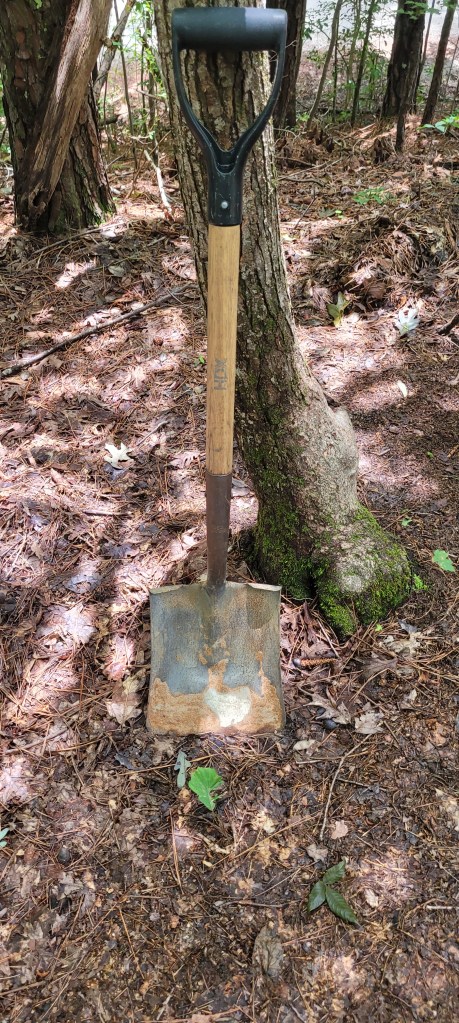
Counterintuitively, a snow shovel is great to have on hand. I was surprised too, but if you think about it, a heavy snow shovel has a sharp edge designed for scraping up ice and snow. That, combined with the wide shovel part of it makes it a great tool for scraping large amounts of loosened dirt up or down slopes to help even out the terrain.
4. Saw
Not a chainsaw, but just a small simple hand saw. I had never used a saw before starting this project, and was totally intimidated by the mere thought of a chainsaw. I assumed I didn’t stand a chance at clearing any land, right? Wrong! A hand saw is actually pretty good at cutting down trees and branches that are just too big for the loppers mentioned earlier (4-6 in).
However, common-sense is also a good idea here as well. Theoretically you could conceivably take down a 50 ft tree with a hand saw, but there are safety considerations. Obstructions like electrical lines or vehicles anywhere within a radius equal to the tree’s height are potential targets for destruction when the tree falls. And, it is very hard to predict which way a tree will fall. Biological organisms rarely follow the laws of physics it seems.
5. Rake
A large rake can be really effective for clearing away loose leaves and debris prior to grading. It’s easy to look at a big patch of underbrush covered in leaves and branches and become overwhelmed. But before assuming you need a mammoth machine to do the job, I prefer to remove the leaves and as much of the underbrush as possible, then identify what trees I can take care of on my own, and what I need help with.
But, on another safety note, loose leaves and underbrush are usually the habitats of snakes and insects. Before reaching down to scoop up a pile of raked leaves, it’s a good idea to look carefully for critters. However, this would be a similar situation even in a well-maintained backyard, and not necessarily a danger specific to manual clearing and grading of undeveloped land.
Conclusion
The beauty of manual land clearing and grading lies not only in the tangible results but also in the personal connection forged with the land itself. Sure, clearing and grading land the DIY way comes with a lot of hard work and sweat, but there’s also something special about working directly with the land, and experiencing a new side of nature. To see what I’m talking about, check out our Instagram for nature pictures of flora, fauna, soil and rocks taken during the process!
If you found this article interesting or helpful, please subscribe to support our project!
 Debt free home project
Leave a comment