To build a debt-free house, it seems obvious that you would need extensive experience as a carpenter or contractor, with a list of skills including building, electrical work, plumbing, and the like – right?
Nope! Think again…

Building a house mortgage-free goes AGAINST the grain of society. Why then, would we want a “professional” who is experienced in the ways of socially accepted, high-cost construction to lead such a project?
Don’t get me wrong, I’m not saying that an experienced carpenter or builder wouldn’t have a lot to bring to the table. BUT, their specific skills are not necessarily the make or break factors in successful debt-free building.
What then ARE the necessary skills needed for a debt-free home project?
(And how can I possibly know if I haven’t yet successfully completed such an undertaking?)
Read on to find out!
1. Willingness to try
It should be obvious that even if someone’s an expert contractor who’s constructed 10 high-rises, if they aren’t willing to give a debt-free tiny home a go then that’s an automatic no-go for the project. Open-mindedness and the ability to step out on faith are indeed skills that can be developed. But many people with great expertise in building may lack these debt-free-critical skills and aren’t even willing to entertain the idea. Conversely, many people like myself may lack building experience, but hey – I’m willing to try.
2. Resourcing
It’s easy to walk into Lowe’s or Home Depot and pay top-dollar asking price for a brand new something or other. But much of what we pay for is not the item nor the quality necessarily, rather the “newness” of it. Learning how to repurpose and reuse goods in creative ways and seek out unconventional sources of materials is key to the debt-free lifestyle.
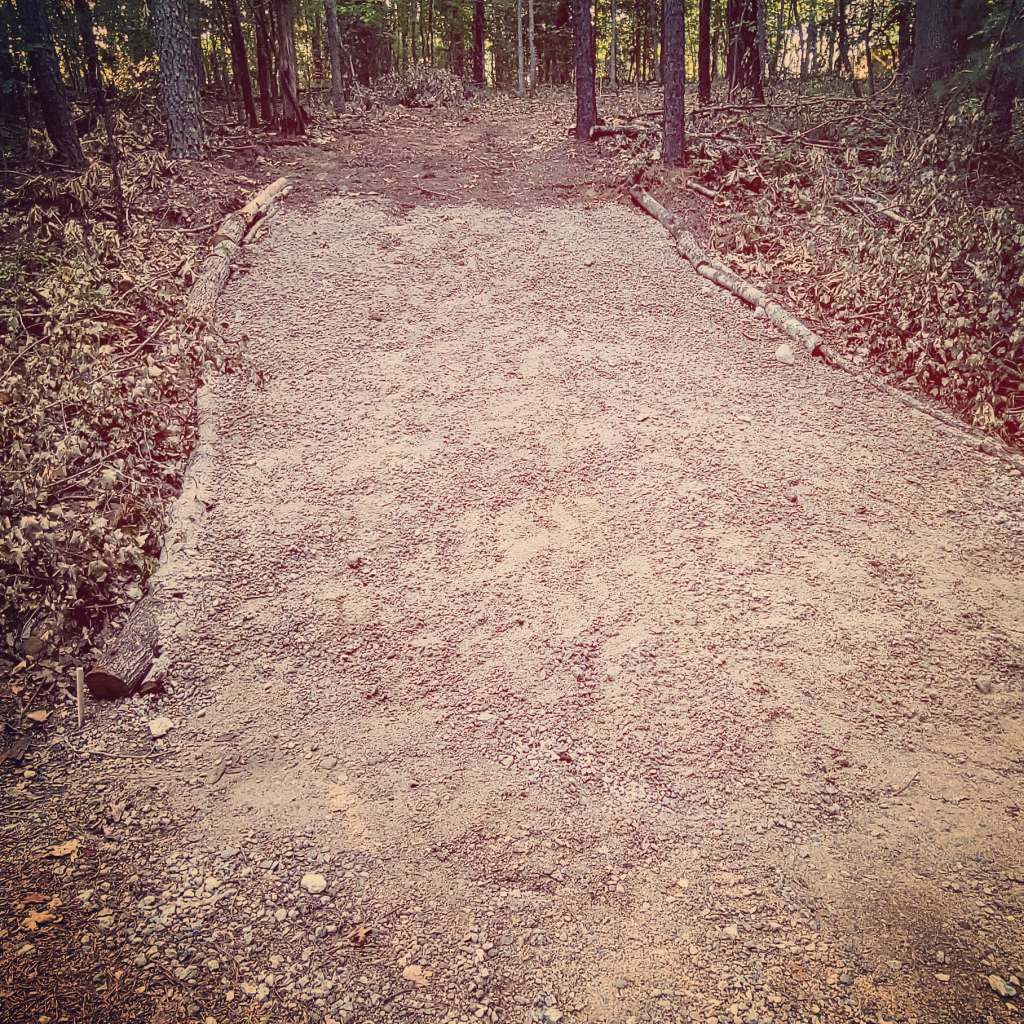
In addition, it’s important to find creative sources for needed materials. For example, crushed gravel that was generated as waste from a concrete mixing factory made a great driveway base.
One person’s trash can literally turn into a treasured piece in your homestead. Building materials and hardware leftover from renovations are routinely put up for grabs on Facebook Marketplace, Craigslist, and similar online sites. I’ve gotten several light fixtures, paint, and other items for free this way. Also if you own the plot you’re building on, the land itself may offer valuable resources. For example, logs from cut trees and rocks found on the property made a great driveway boarder and helped with grading. Alternatively, items like firewood, fill dirt, and rocks for landscaping can be sold to generate additional funds for your project.
3. The ability to let go
Getting rid of things might seem like a waste, the opposite of saving money. After all, we want as many things as possible for somewhere between $0 – Free in order to live debt-free, right? Not necessarily.
Value comes from quality and usefulness of items, not just any random junk sitting around. Further, keeping unnecessary items can add up in cost over time: storage fees, moving costs, etc. Also, downsizing can help us appreciate the items we really need and value – the one’s we didn’t see before because they were hidden under all the junk.
There are plenty of options for ridding yourself of cluttering mementoes and items no longer needed: yard sales, selling on Facebook Marketplace or Craigslist, giving away for free, donating to Goodwill, Habitat for Humanity ReStore, a thrift store, and more. However, to do this means having the courage to let go of items that no longer have a place.
4. Curiosity
Curiosity and the desire to learn new things is critical to any new project. It isn’t about how easily you feel you learn new things, rather that you enjoy it. Seeking to grow and further yourself is critical to being able to solve problems and come up with new ideas.
Learning isn’t about obtaining a certain “education” or attending a certain institution. Learning is free! Learning can be anything from watching YouTube tutorials to trying out new ways of building furniture on your own. In fact, the most valuable learning that can take place is in the form of gaining real-life experience.
5. Work-Ethic
Just because the home takes less money to build doesn’t mean there won’t be any cost. #SweatEquity.
Without the willingness to get your hands dirty and jump in, do some hard work, and learn those new skills, then we’re back to paying someone else to do everything for us. Plus, the dedication and perseverance to work using the tools that are available to you can help you understand the gifts you have and the skills you didn’t have to work for.
People can be rich in more ways than just finances. There are many many gifts you may possess that are alternative forms of “wealth”. For example, health to do physical work yourself is a huge blessing. Having computer access and the ability to source good materials for cheap is a big advantage. A good gut instinct for finding honest workers is another large asset. The ability to multitask and coordinate parts of a project with ease might be another gift. Instead of looking at what you’re lacking, focus on the rich blessings you DO have. What are your gifts?
6. Flexibility
Getting good deals and finding materials to reuse is often a matter of opportunity, and it may not be possible to plan out everything in advance. Also, being flexible about the aesthetics and design of your home can literally mean the difference between hundreds to thousands of dollars or $0 in some cases. It isn’t even necessarily about compromising and “settling” for less. Sometimes this flexible mindset can lead to ending up with even better items than you might have originally chosen!
For example if you’re dead set on purchasing all the lighting fixtures for your home next Saturday, and they should all be in a brushed chrome finish with crystal glass accents, you might miss out on the free chandelier someone put up on Craigslist the day before, or the liquidated fluorescent light fixtures with 50,000 hr bulb life at the thrift store for $0.50 cents each. Serendipity can lead you to great finds but only if you’re open to it!
7. Vision
Sometimes it can be hard for others to see the picture you have in your head. A vision of your end goal helps avoid getting sidetracked by discouragement. But setting, holding, and maintaining this vision throughout hard times and disappointments is a skill requiring practice.
A “vision” doesn’t necessarily have to be a picture of what your ideal future home would look like. Rather, it can be a goal, purpose, divine inspiration, ethic or value, or anything that gives you a sense of direction for your project.
A sense of direction is a reason to keep going when the odds tell you to stop. Building a debt-free home in 2023 is not a small, simple task. It is an adventurous project, requiring a large investment of time, energy, and faith. A DIY home has the potential to be far more rewarding than a mortgage in more ways than just financial. However, your purposeful vision of your future home, and why you are building it is necessary to keep you motivated and moving forward.
8. Resiliency
Along with maintaining a vision of your end goal is the determination to see it through. But determination is different than just wanting something “bad enough”. Often, the hardest part of remaining determined is bouncing back from setbacks and discouragements. Disappointments can easily be misinterpreted as signs that you “can’t do it” or “don’t have what it takes”.
However, when things don’t go as planned, it doesn’t mean all your efforts were a waste. Failures aren’t a representation of your inadequacy. Rather, these detours on the route to success are part of the process! Further, you can use setbacks to help propel you forward in ways you wouldn’t have expected. For example, getting turned down for a mortgage can lead to your starting a debt-free home project!
Also, many roads can lead to your end goal. At times it may feel as though you’ve fallen off the path set before you. You may have to wander through dense forests and climb uphill, and it may seem as though that one mistake left you doomed to be lost forever. But as long as you have your compass set in the direction of your goal, and don’t give up, you’ll eventually get there. You’ll have made your own trail and, who knows, it may just end up being a better way. Further, we can’t always know what would have happened “if”. If you had stayed on the original path, maybe you would have fallen down and gotten hurt. Maybe the unique path that you fell onto was the perfect one after all!
9. Creativity
Let’s face it, currently, building a home debt-free is a very nontraditional project. This undertaking therefore requires thinking in a nontraditional way. For example, old bricks could become a rustic walkway. shop lights could become recessed lighting, logs could become landscape boarders, etc.
Creativity also incorporates the acceptance that things don’t have to cost as much as they do, just because everyone else says so. A trap we can often fall into is the “that’s just how it is” mode of thinking. For example, ” A decent home nowadays costs $300,000 in this market. That’s just how it is.” But if we can break free of the way that everything “has to be”, there’s room for creativity and inspiration to take place.
Creativity doesn’t have to mean you’re artistically inclined or have a great imagination. It can be as simple as taking note of mainstream thought patterns that make you feel depressed or demotivated, and questioning their validity and importance. If the path you’re “supposed” to take suddenly wasn’t there anymore, what are your options? Maybe there’s a better alternative…
10. Decision-making
Decision making isn’t necessarily the ability to make good decisions. Rather the ability to commit to a decision. I’m often caught in “decision paralysis”, the inability to decide on a course of action. However, given the two following scenarios, which one would you choose? 1) You make a bad decision that wastes $500. 2) You don’t make any decision and are stuck there indefinitely.
Fear of going down the wrong path can be incapacitating, and ultimately prevent you from reaching your goals. Society tends to classify decisions as either “right” or “wrong”. However, on a project as individual as building your own home, it isn’t a question of taking the “correct” path, rather of taking a path at all.
Some paths may be harder than others. During these times of challenge its easy to become fatigued and start doubting yourself and your ability to make “good” decisions. But if you think about it in terms of a long trek, there will be some sections that are more difficult and exhausting than others. Yet, there will also be stretches that are smoother and easier.
Does it really matter which path was taken as long as you reached your end destination? Further, if you had only made “good” decisions and chosen only the trails that were smoothest and easiest on the trek (the paths of “least resistance”) is that really the best route long-term? If you’re looking to increase your endurance to prepare yourself for a long hike, would you want to always take the easy roads, or would you aim to try out some rougher terrain? This comes with the risk that you might not be able to finish the trek. But you can always try again on a different route.
If you’ve found this article helpful, please subscribe below to follow the story!
 Debt free home project
Leave a comment